
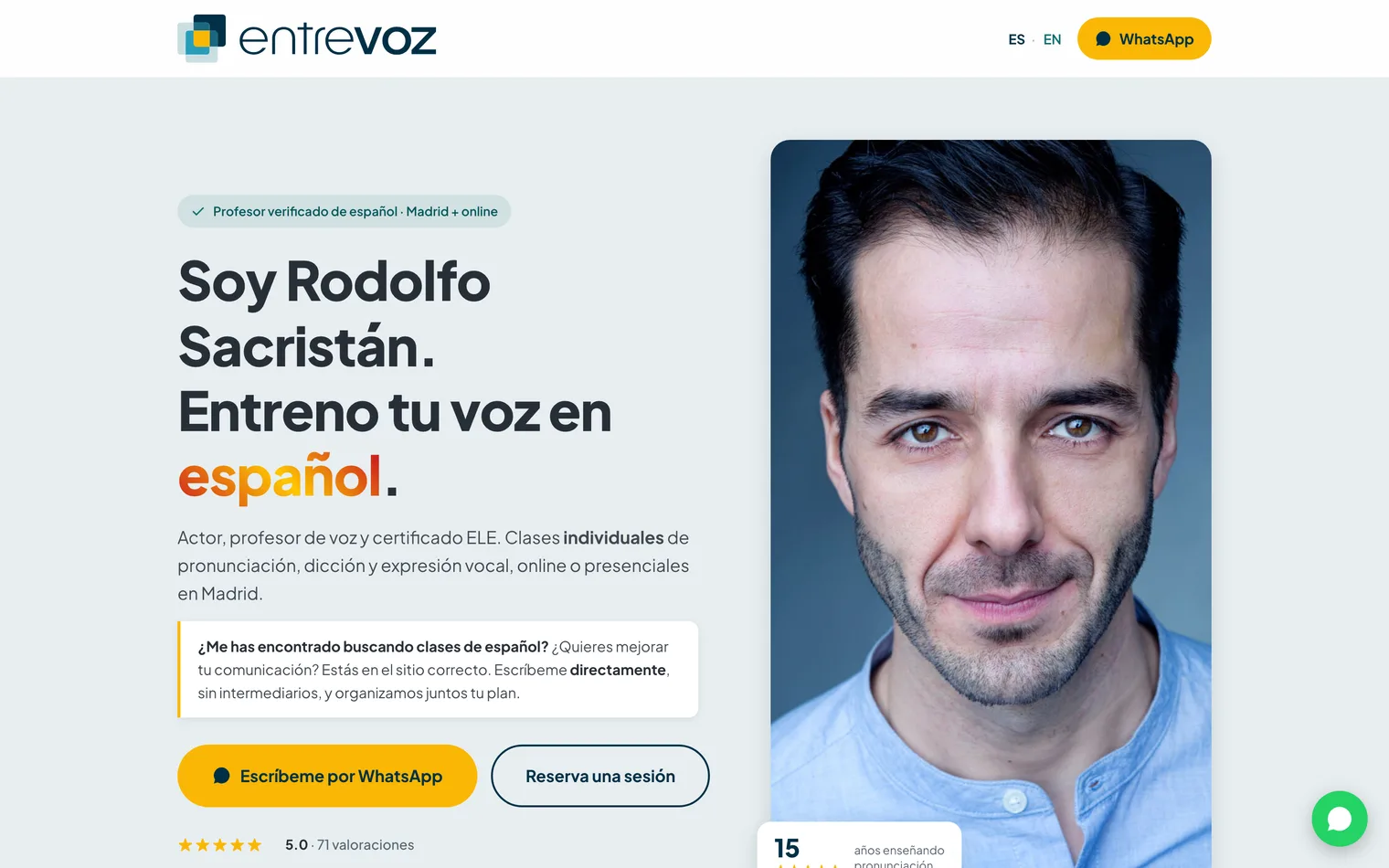
entrevoz teaches Spanish pronunciation, diction and vocal expression. Rodolfo, who runs it, is an actor and a Spanish teacher, and his students come from more than 20 countries. Most of his teaching happens one to one. The school needed a place where it could also exist as courses: a website that explains the offer, a platform that teaches, and exercises that do something a PDF cannot.
A website without a page builder
The first version was built in Elementor. In September I rebuilt it as a hand-coded WordPress theme that looks the same and carries a fraction of the weight. Eight plugins went, Elementor among them; one add-on that connected the course plugin to Elementor added 111 KB to every page and did nothing. The homepage now loads 10,285 bytes of compressed CSS.
The turning point came from the editing side. The first rebuilt version gave Rodolfo empty form fields and no way to see what a change would do. Editing blind. So every text on the site now sits in one panel with a live preview, filled with the copy that is already on the page. Titles, descriptions and share images are fields in that same panel, which is why the site runs without an SEO plugin. A new page takes three files and is editable in exactly the same way.
The course platform
Courses run on Tutor LMS, with Stripe for single courses and memberships. A lesson can hold interactive H5P exercises, and it only counts as completed once its exercises have been done. Done, not passed: the point is practice, not a grade.
The practice tools
This is the part you cannot buy off the shelf.
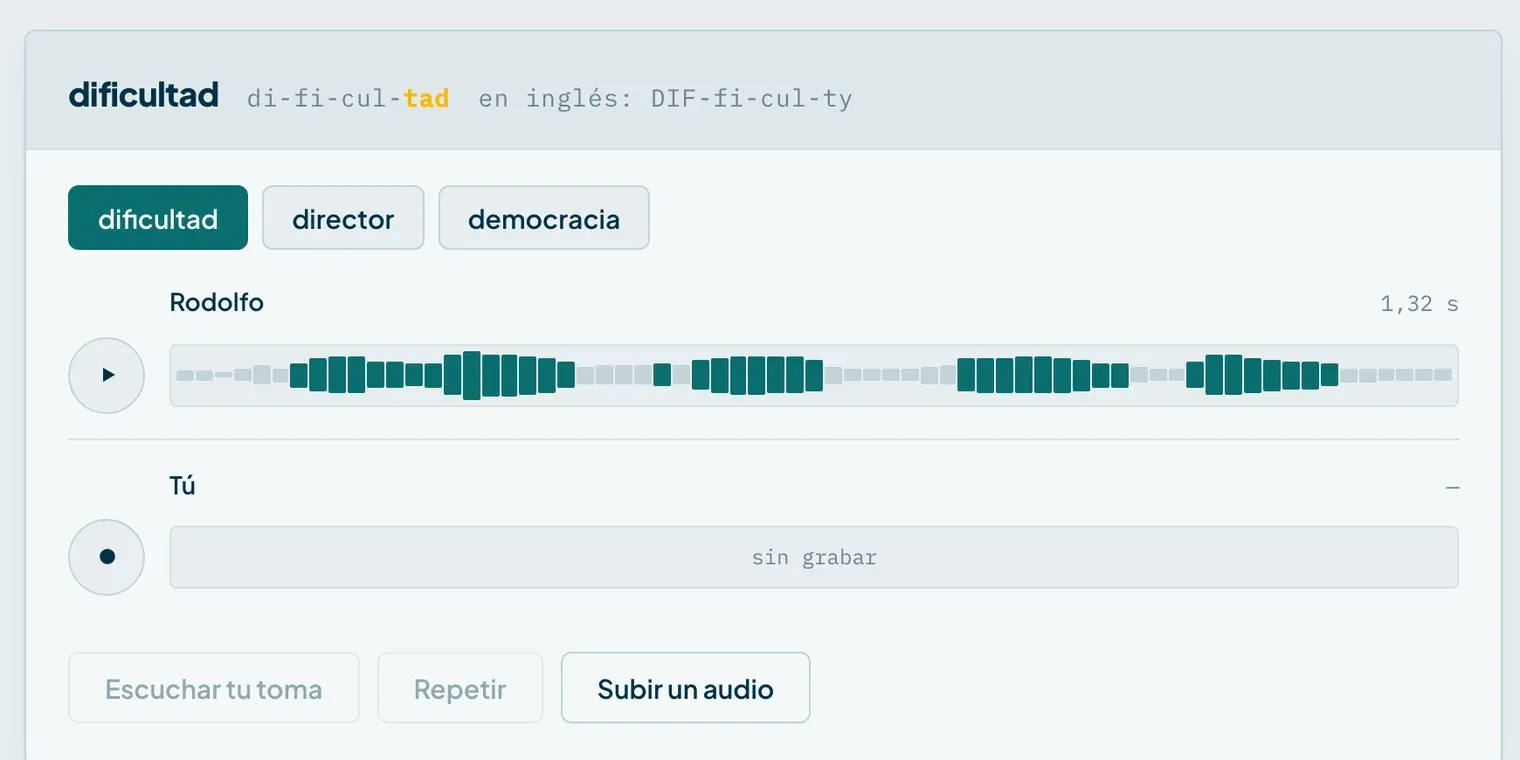
- Recording test. The student hears Rodolfo say a word, records themselves, and sees their waveform under his on the same time axis. Take longer and your wave sticks out on the right. H5P has no content type for this, so it is a custom one. In the platform the take goes to Rodolfo, who answers with a voice note inside the same lesson, and recordings are stored privately rather than in the public media library.
- Synchronised transcript. The audio plays while the text follows syllable by syllable, with the stressed syllable marked.
- The hum. A sentence reduced to its melody, words removed, so the student hears intonation without meaning getting in the way. Checked on one of Rodolfo’s own videos: the pitch curve matches the original almost exactly (correlation 0.99), and a speech recogniser finds no words in it at all.
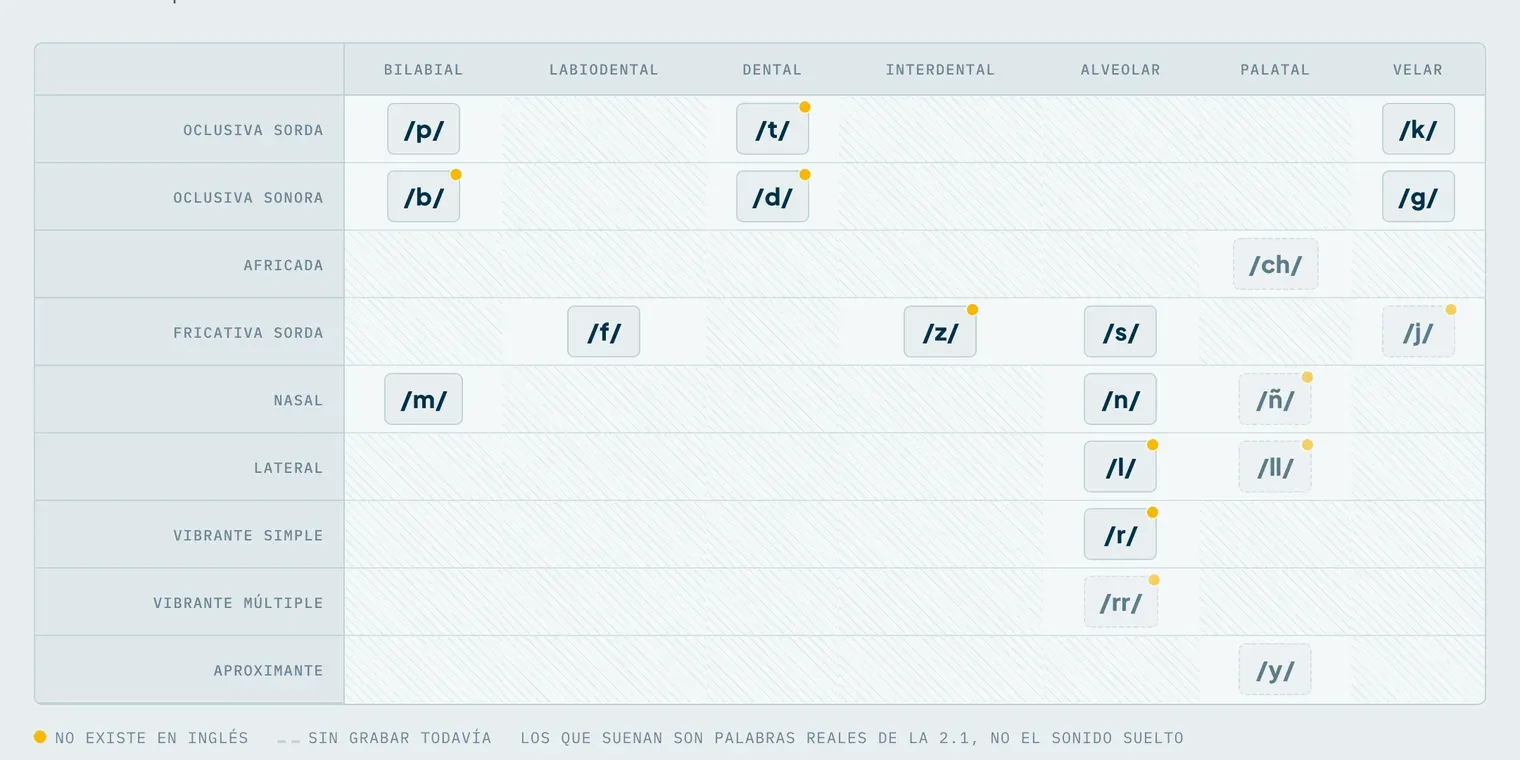
- The sound table. Spanish has 27 letters and 24 sounds, and they don’t line up. A table of letters would teach things that are not true, so this one is ordered by sound and by where in the mouth it is made.
- An editor for Rodolfo. He creates and publishes exercises himself, every change keeps a version he can return to, and aligning the transcript to a new recording is one button.
He records his lessons with a teleprompter that is a project of its own: entreprompter.
What turned out to be false
The first waveforms were decoration. The early exercise pages drew 34 bars per recording with a random generator. They looked like sound. In a pronunciation course that is worse than nothing, so they were replaced with waveforms computed from the audio file itself.
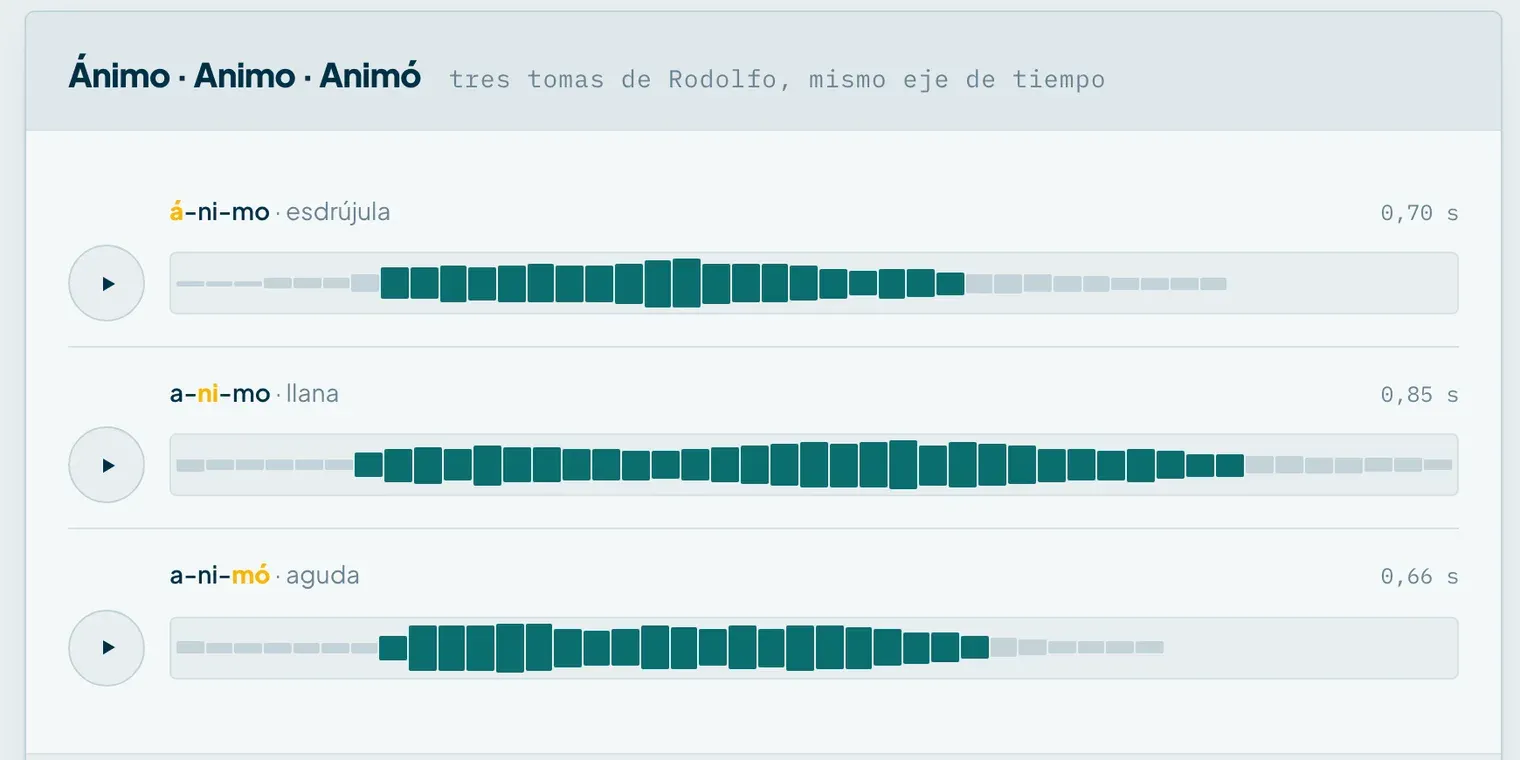
And then the real waveform didn’t show what I expected either. I was about to write on the recording test that the wave shows where the stress falls. I measured it first, on three real takes by Rodolfo: the same letters with the stress in a different place each time (ánimo, animo, animó). It is false. In Spanish, stress lives in pitch and duration, not in loudness. What the wave does show is rhythm: how long you take compared with him, where you stop, whether you swallow a syllable or drag it. So that is what the page now promises, and the page checks itself every time it loads.
A library that copies is not a library that syncs. Tutor’s content bank looked like central maintenance: change a lesson once and every course follows. A click-through test showed that adding a lesson always copies it, and changes in the bank never reach the copies. It is a template library. The exercise editor was built for that, not for what I had assumed.
Where it stands
The landing page is live in Spanish and English. The platform is built and still behind a password; it opens when the first courses are ready.
On the method
I built this with an AI coding agent doing the repetitive part, on days that touched over a hundred files, and with H5P packages that fail silently on details such as language files being matched by position instead of by name. The agent did not decide that a waveform has to be real, that a table of letters teaches the wrong thing, or that Rodolfo must be able to change an exercise without waiting for me. Those decisions came from watching how he teaches.
The waveform shows rhythm, not stress. For stress you need the teacher's ear, and that is exactly what the school sells.
Have a project like this one?
Tell me what you're planning. I'll tell you honestly whether I can help, and what it would take.
Tell me your project →You'll deal with me directly, from first call to final delivery.